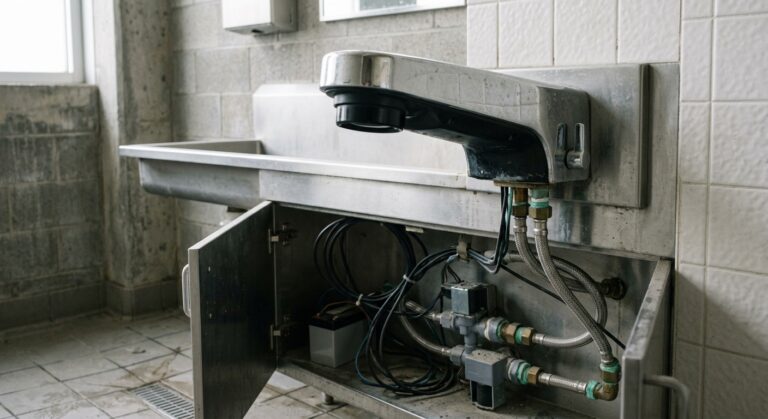

Freeze protection in a terminal restroom cannot rely on isolating the fixture and draining the line, because the exposure window and the demand peak are the same two weeks. You heat-trace the supply, you install freeze-sensing auto-drain valves at the low points, and you keep the fixture live through the event rather than shutting it down. Treat this as a reliability problem for a fixture that cannot go offline, not a seasonal maintenance task you schedule around.
Why Storm Season Spikes Restroom Demand
Holiday travel weeks routinely push airport passenger volumes well above baseline, and weather delays compound that by holding passengers in terminals longer than scheduled. A regional snowstorm that grounds a bank of flights can turn a three-hour dwell time into eight hours for several hundred people at a single gate cluster. Restroom fixture counts are sized to code-minimum ratios for scheduled throughput, not for delay-driven dwell time, so the fixtures nearest the affected gates see sustained above-design use exactly when outside temperatures are dropping fastest. A fixture that goes offline for freeze protection during that window does not get a quiet replacement cycle. It gets a line.
Mapping Unheated Risk Zones in Terminals
Not every restroom in a terminal carries the same freeze exposure, and treating them identically wastes budget on low-risk zones while under-protecting the ones that matter. Walk the building with mechanical drawings in hand and flag these categories separately:
- Jet bridge restrooms and the supply runs feeding them, which pass through unconditioned bridge structures exposed directly to ambient air.
- Satellite concourse fixtures fed by supply mains routed through parking structure mechanical chases or rooftop penthouses.
- Curbside and ground-transportation-level restrooms near loading docks, vestibules, or overhead doors that cycle open frequently.
- Any fixture downstream of a recirculation loop that terminates before reaching an unheated branch, leaving that branch with static water and no circulation.
Pull low-temperature alarm logs from the BMS for each zone from the prior two winters if you have them. Zones that alarmed before are not a one-time anomaly; they are a map of where insulation, heat trace, or line routing failed under actual storm load.
Heat-Traced Supply Lines for Sensor Faucets
Self-regulating heat trace cable rated at a minimum of 3 watts per foot is the standard spec for exposed domestic water supply runs feeding sensor faucets in unconditioned terminal spaces. Self-regulating cable matters here specifically because sensor faucets draw intermittently; the cable needs to ramp output automatically as pipe wall temperature drops between activations rather than running at a fixed wattage that either underheats during a cold snap or wastes energy during milder weeks. Specify cable with integral temperature sensing or pair it with a line-sensing thermostat set to activate in the mid-30s Fahrenheit, not a simple on/off timer, since ambient air temperature in a jet bridge chase does not track terminal HVAC schedules.
Install the cable per manufacturer spacing on straight runs and add extra wrap at valve bodies, unions, and the solenoid assemblies described below, since these components have more exposed surface area and no continuous water flow to carry heat. Insulate over the cable, not instead of it. Insulation without heat trace only slows the freeze; it does not prevent it on a run that sits static overnight when terminal traffic drops to near zero.
Auto-Draining Valves for Jet Bridge Fixtures
Jet bridge fixtures are the highest-risk category because the bridge itself is the least thermally stable space in the building, open to ambient air on three sides and subject to direct wind exposure when connected to an aircraft. Specify solenoid valves with integrated freeze sensing that trigger an auto-drain cycle when pipe temperature drops below roughly 36°F, well ahead of the actual freeze point, giving the system margin for sensor lag and for the time it takes residual water to evacuate the line. The valve should fail open to drain on loss of power, not fail closed, since a power interruption during a storm is exactly when you most need the line to clear.
The trade-off with auto-drain valves is that the fixture is briefly non-functional during the drain-and-refill cycle, typically under a minute, which is acceptable if it is automatic and infrequent. It becomes a problem if the sensing threshold is set so conservatively that the valve cycles repeatedly during normal cold weather rather than only during genuine freeze risk. Commission these valves with a facilities tech on site during the first cold snap each season and adjust the setpoint based on actual pipe behavior at that location rather than trusting the factory default across every jet bridge in the terminal.
Keeping Fixtures Live During Freeze Events
IPC Section 603.4 and the equivalent UPC provisions require protection of water piping in spaces subject to freezing, and most jurisdictions interpret this to mean either heat trace with insulation, auto-drain capability, or relocation of the piping into conditioned space. None of these code paths assume the restroom goes offline; they assume the piping is protected so the fixture keeps running. Build your freeze protection plan around that reading rather than around a shutdown-and-reopen cycle that satisfies nobody during a storm week.
During an active freeze event, keep faucets cycling rather than idle wherever occupancy allows it. Sensor faucets with a programmable standby flush, even a brief periodic cycle during confirmed sub-freezing conditions, keep water moving through the exposed segment of line and reduce reliance on heat trace alone to prevent a freeze. Coordinate this setting with water conservation goals; it is a storm-week exception, not a year-round setting. When specifying or replacing fixtures for these zones, commercial-grade units built for continuous-duty cycling hold up better under this kind of intermittent forced-flush operation than residential-grade sensor faucets, which is one more reason to source commercial restroom fixtures rated for high-cycle use rather than retrofitting residential units into a terminal application.
Supply Line Risk Comparison
| Zone type | Typical exposure | Primary protection method |
|---|---|---|
| Jet bridge restroom | Direct ambient and wind exposure, three-sided | Heat trace plus auto-drain solenoid |
| Satellite concourse chase | Enclosed but unconditioned, moderate wind | Heat trace with insulation, line-sensing thermostat |
| Curbside vestibule | Intermittent exposure from door cycling | Insulation plus periodic flush cycle |
| Recirculation dead-leg | Static water, no flow protection | Reroute or add dedicated heat trace |
Pre-Winter Checklist for Facility Teams
- Pull low-temperature BMS alarm history from the prior two winters and flag repeat-offender zones for priority inspection.
- Verify heat trace cable continuity and wattage output at every exposed run before the first forecasted sub-freezing week.
- Test auto-drain solenoid valves manually, confirm fail-open behavior on simulated power loss, and log the current setpoint.
- Confirm insulation is intact over heat trace, not just over bare pipe, especially at recent repair points.
- Review standby flush programming on sensor faucets in jet bridge and curbside zones ahead of the first storm forecast.
- Document which code section (IPC 603.4 or local UPC equivalent) your protection method satisfies, for the inspection file.
Walk the flagged zones with a contractor who can verify heat trace output with a clamp meter rather than a visual check, since a cable that looks intact can still be under-delivering wattage at a damaged splice. If a jet bridge restroom alarmed more than once last winter, that is not a maintenance ticket, it is a redesign flag, and it should move to the top of the capital list before the next storm season rather than waiting for the annual budget cycle.