
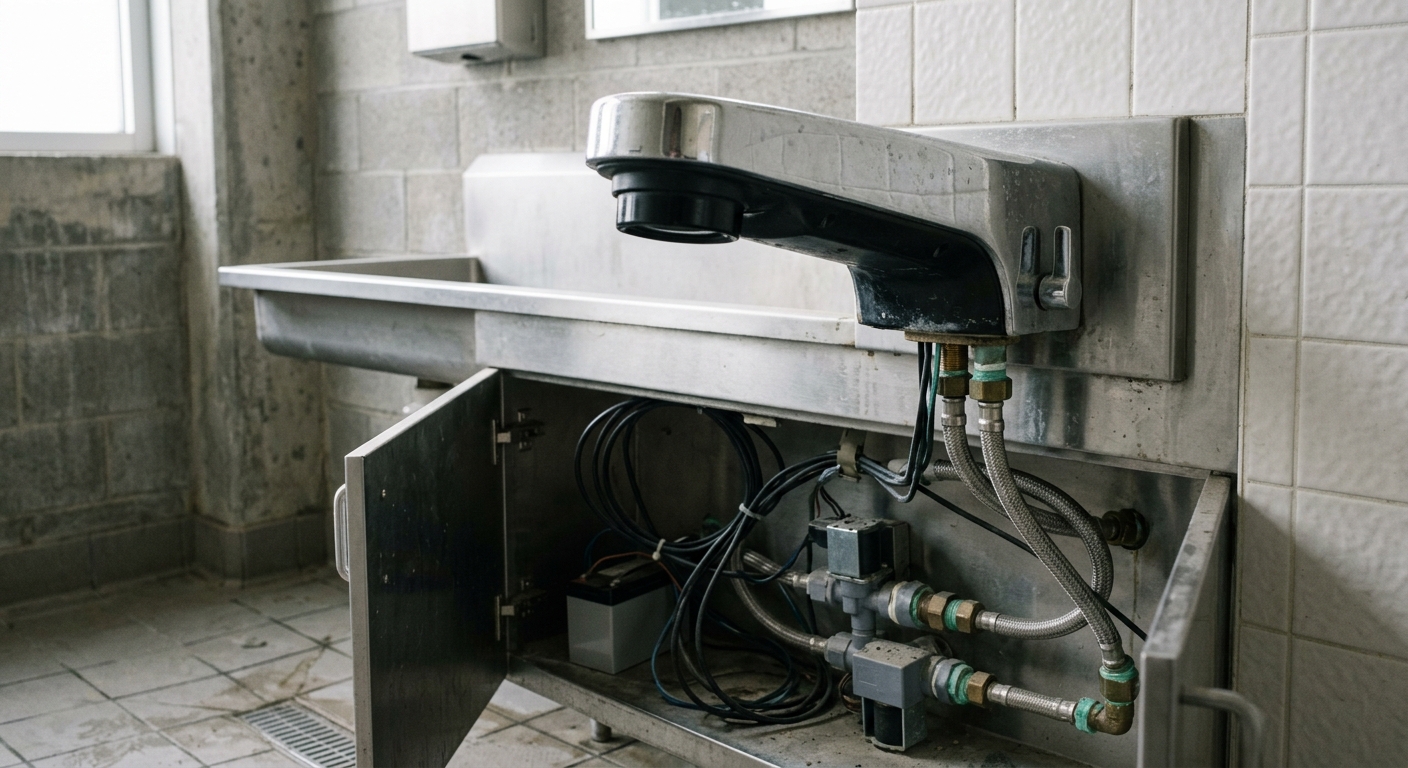
Touchless faucet sensors in terminal restrooms fail for three reasons: the duty cycle exceeds what the solenoid and sensor were rated for, cleaning chemical film changes the infrared range, and power source (battery vs AC) isn’t matched to actual usage volume. This is a math problem, not a wear-and-tear problem. A fixture rated for 100,000 cycles that gets hit 3,000 times a day during a bank surge is on a different failure timeline than the same fixture in an office breakroom.
Peak Bank Surges vs Sensor Duty Cycles
A single wide-body arrival bank can push 400 to 600 people through a restroom bank in under 30 minutes. If that restroom has 8 lavatories, each faucet may see 50 to 75 activations in that window alone, then sit mostly idle until the next bank. Manufacturers rate sensor faucets and solenoid valves in total cycle counts, not years of service, and that rating assumes a roughly even distribution of use. Terminal restrooms don’t distribute evenly. They spike hard, then go quiet, then spike again, and the solenoid is doing the same number of total cycles in a compressed, repeated burst pattern that generates more heat and more mechanical fatigue per unit of calendar time than the rating was tested against.
This matters for procurement. When you’re sizing a restroom bank against expected passenger throughput, back into daily cycle count from the design gate capacity, not from a generic “high traffic” spec sheet line. A faucet rated for 500,000 cycles sounds durable until you divide it against three peak banks a day, 365 days a year, for the life of the terminal.
Infrared Range Drift From Cleaning Chemical Film
Most commercial IR proximity sensors are tuned for a 4 to 6 inch detection range. That range is calibrated against a clean lens. Quaternary-based disinfectants and some glass cleaners leave a thin film on the sensor window after repeated wipe-downs, and that film scatters or attenuates the IR signal. The practical effect is a faucet that either stops triggering at the expected distance (users wave harder, closer, or give up) or triggers erratically because the film creates inconsistent reflection.
This isn’t a defect. It’s a maintenance interaction that most janitorial contracts don’t specify correctly. Range drift from film buildup is progressive, so a faucet that worked fine on Monday can be unreliable by Thursday without any hardware change. Facilities that track sensor complaints by day of week rather than by fixture usually find the pattern lines up with cleaning chemical dwell time and wipe frequency, not with fixture age.
AC-Powered vs Battery-Powered Sensor Faucets in 24/7 Zones
Terminal restrooms that run continuous service (which is most of them, given red-eye departures and international arrivals) are a poor fit for battery-only sensor faucets unless the battery is a large-capacity pack designed for commercial cycle counts. The tradeoffs:
| Power Type | Advantage | Limitation in Terminal Use |
|---|---|---|
| Battery (AA/lithium pack) | No electrical rough-in required, easier retrofit | Battery life measured in cycles, not months; high-traffic banks can deplete packs faster than scheduled swap intervals |
| AC (hardwired, transformer) | No battery replacement cycle, consistent solenoid response voltage | Requires electrical rough-in at rough-in stage; harder to retrofit into existing slab |
| AC with battery backup | Continuity during power interruption | Higher unit cost, more points of failure to diagnose |
For new construction or major renovation, AC-powered is the standard choice for terminal restroom banks because the cycle volume makes battery replacement scheduling a real maintenance burden. For retrofits where conduit isn’t available, battery units with commercial-grade cycle ratings are workable, but the replacement schedule needs to be tied to actual cycle counts, not a calendar guess.
False Triggers From Queue Lines and Luggage
Restrooms adjacent to gate queues or baggage claim see false triggers from luggage passing through the sensor field, people standing closer than the design clearance while waiting, and reflective clothing or bag surfaces at the wrong angle. Every false trigger is a wasted solenoid cycle and a small amount of wasted water, and at terminal volumes that adds up to real numbers on the water bill and a shortened solenoid service life.
The fix is usually mechanical, not electronic: sensor faucets with a narrower, more focused detection cone reduce false triggers from ambient movement compared to units with a wide-angle sensor field. If a restroom layout puts sinks close to a queue path or a luggage staging area, spec the narrower-range unit even if the wider range seems more “responsive” on paper.
Cleaning Crew Workflows That Protect Sensors
- Wipe the sensor lens with a dry or lightly damp microfiber cloth after chemical application, not during, to prevent film buildup from drying on the lens.
- Avoid spraying disinfectant directly at the sensor window; spray the counter or basin and wipe outward.
- Log sensor complaints by fixture and by shift so range drift patterns show up before a full failure.
- Include sensor lens cleaning as its own checklist line item, separate from general counter wipe-down, so it isn’t skipped when crews are moving fast during a turnaround window.
Turnaround cleaning crews are working against a schedule, not against a sensor spec sheet, so the checklist has to be explicit. “Clean the counter” does not reliably produce “clean the sensor lens.”
Choosing Solenoid Valves for High-Cycle Counts
Solenoid valve cycle life ratings vary by manufacturer and by valve design, and this is the number that should drive fixture selection for terminal restrooms more than any other spec. A valve rated for standard commercial use may be tested to a lower total cycle count than a valve built specifically for high-traffic public restrooms. When comparing commercial touchless faucets for a terminal application, ask for the solenoid cycle rating explicitly and calculate expected daily cycles from projected passenger counts before assuming a “commercial grade” label is sufficient for your volume.
Also confirm operable force and clearance against ICC A117.1 and ADA requirements: sensor faucets don’t require manual operating force since there’s no lever or handle to push, but mounting height and knee/toe clearance under the lavatory still need to meet the standard reach ranges, and any manual override or temperature control on the unit needs to fall within the 15 to 48 inch reach range if it’s classified as an operable part.
Before your next fixture spec or RFP, pull actual cycle-count data from your busiest restroom bank during a peak arrival period, not an average day. Match that number against the solenoid’s rated cycle life with margin, not at the ceiling. If sensor complaints are already happening, check the cleaning crew’s wipe-down sequence before assuming the unit is defective, and if range drift persists after lens cleaning, that’s the point to call the manufacturer’s technical support or your fixture rep rather than continuing to swap batteries or units on a guess.
