
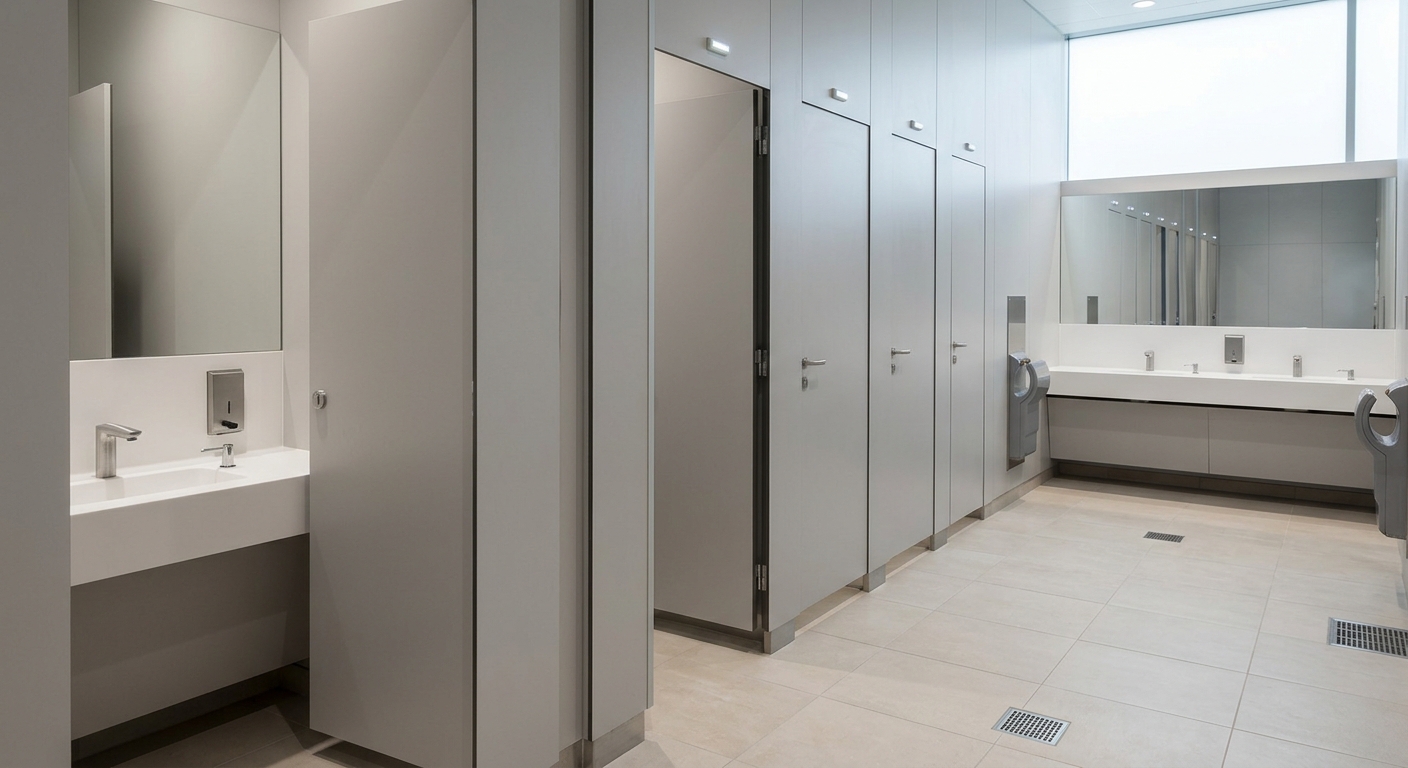
Touchless faucets in airport restrooms wear out fast because they are built to residential or light-commercial cycle counts, not aviation cycle counts. A terminal restroom fixture near a busy gate can see thousands of activations a day, closer to the duty cycle of an aircraft lavatory tap than a home kitchen sink. The fix is not a better sensor. It is specifying hardware designed around the same constraints aircraft interiors have solved for decades: low mass, small envelope, and components rated for continuous high-frequency use.
Why Aircraft Lavatories Limit Fixture Size
Aircraft lavatory fixtures are small because every ounce and cubic inch has a cost against payload and fuel burn. That constraint forced a design language of compact valve bodies, short-throw actuators, and low-mass spouts long before “space-saving” was a bathroom marketing term. The byproduct of that weight discipline is mechanical simplicity: fewer moving parts, shorter wear paths, and components sized to survive constant cycling in a footprint measured in inches, not feet.
Terminal restrooms operate under a similar throughput problem without the weight penalty, but the cycle-count problem is identical or worse. A single fixture near an international gate can outpace the lifetime activation count of a residential faucet within a year. Borrowing the aviation design logic, compact body, minimal moving mass, sealed low-mass solenoid, gives facility operators a fixture built for the actual load profile instead of a residential unit pressed into industrial service.
Compact Envelope Specs For Terminal Stalls
Terminal counters are shrinking as design teams pack more fixtures into the same linear footage to shorten queue times. That means faucet bodies need a smaller footprint both above and below the counter. Look for spout heights under 6 inches, deck footprints under 3 inches in diameter, and valve bodies that clear a 27 inch ADA knee clearance without an oversized escutcheon eating into that dimension.
Undercounter clearance matters as much as the visible fixture. ADA requires a minimum knee clearance of 27 inches from the finish floor to the underside of the counter or fixture housing. A faucet with a deep solenoid body or an oversized mixing valve can eat into that clearance even when the spout itself looks compact. Confirm the full wetted assembly, not just the spout profile, against the 27 inch line before specifying.
Sensor Range In Tight Counter Spaces
Aircraft lavatory faucets use short-range activation because the counter depth gives them no other option. Terminal restroom counters, particularly in retrofit stalls, often have the same shallow depth. A sensor tuned for a 12 inch detection range will trigger on the user in the next basin, on a passing cart, or on nothing at all.
Specify sensor detection range of 4 to 6 inches for tight counter installations. This range is narrow enough to avoid cross-triggering between adjacent basins spaced 20 to 24 inches apart, center to center, which is common in high-density terminal layouts. Confirm the sensor’s field is adjustable or factory-set within that band before installation, not after, since field recalibration on a sealed sensor housing is often not possible.
Matching Fixture Weight To Wall Mounts
Low-mass fixtures are not just an aviation weight-budget artifact, they also reduce mounting stress in high-cycle installations. A heavier spout assembly on a thin-wall counter mount transmits more torque to the mounting hardware every time it is bumped, leaned on, or hit with a cart. Over thousands of cycles that torque loosens deck mounts and cracks sealant lines faster than the valve itself wears out.
Wall-mounted units carry a parallel concern. Confirm the rough-in blocking is rated for the fixture’s actual installed weight plus expected impact load, not just static weight. A fixture rated for residential wall mounts may be structurally fine on day one and loose within a year under terminal-level bump and lean traffic. This is a rough-in decision made before drywall goes up, so it needs to be part of the fixture spec conversation, not an afterthought during punch list.
Cleaning Cycle Speed Per Fixture
Turnaround cleaning time per fixture is where the aviation design template pays off most directly for facility operators. Fewer exposed seams, a single-piece spout body, and a sealed sensor housing all reduce the number of surfaces a custodial crew has to wipe, disinfect, and dry per pass. On a fixture cleaned dozens of times a day across a terminal restroom bank, shaving even fifteen seconds per fixture compounds fast across a full custodial shift.
The comparison below outlines what to check when a fixture is marketed as “commercial grade” versus what actually shortens cleaning time in a terminal environment.
| Feature | Why It Matters For Turnaround Cleaning |
|---|---|
| Single-piece spout body | No seam at the base to trap grime or require separate wipe-down |
| Sealed sensor housing | Can be wiped with disinfectant without risk of moisture ingress |
| Flush deck mount | No gap between spout base and counter for debris or standing water |
| Matte or brushed finish | Shows fewer fingerprint and water spots between full cleanings |
None of these features are aviation-exclusive, but aircraft lavatory design has been optimizing for exactly this combination, minimal surface area, sealed components, no trap points, for longer than commercial restroom fixture manufacturers have treated it as a design priority. The same logic that shapes compact aircraft galley fixtures or modern shower heads built for tight footprints applies directly to a terminal counter where every fixture gets touched, and cleaned, hundreds of times a day.
Valve Choices For High Cycle Counts
Flow rate and thermal control both need to be specified with cycle count in mind, not just water use. Touchless faucets in this application typically run near 0.5 GPM (1.9 LPM), well under the federal 2.5 GPM cap for showerheads and far below typical kitchen faucet flow, because the activation is brief and the use case is handwashing, not filling a basin. That low flow also reduces splash-back onto the counter and sensor housing, which in turn reduces the film buildup custodial crews have to clean.
Scald protection matters more in high-cycle installations because the valve is opening and closing far more often than in a residential setting, increasing the number of opportunities for a thermal shock event if the mixing valve is undersized or uncontrolled. Specify a faucet or point-of-use mixing valve that meets ASSE 1070 for thermostatic mixing. This standard sets maximum outlet temperature limits and requires the valve to maintain safe blended water temperature even under fluctuating inlet pressure or temperature, which is common in a terminal building’s shared hot water loop feeding dozens of fixtures simultaneously.
- Confirm sensor detection range is factory-set or field-adjustable within 4 to 6 inches before ordering for tight counter layouts.
- Verify the full wetted assembly, not just the spout, clears 27 inches of ADA knee clearance.
- Request ASSE 1070 compliance documentation for any thermostatic mixing valve in the spec.
- Check rough-in blocking rating against installed fixture weight plus expected impact load for wall-mounted units.
- Walk a mockup installation with the custodial team before full rollout to time actual cleaning passes per fixture.
Before finalizing a terminal restroom fixture order, pull the cut sheet and confirm sensor range, wetted-assembly depth, and ASSE 1070 compliance directly from the manufacturer rather than from marketing copy. If the spec sheet does not list a cycle-count rating or duty-cycle test basis, ask for it in writing before the purchase order goes out. A facility engineer or plumbing contractor familiar with high-cycle commercial installations should sign off on rough-in blocking and mixing valve selection before drywall and counter work locks in the final dimensions.

Silas Trent is a staff writer and editorial team member at touchlessaviationfaucets.com, covering airport touchless faucets, sensors, power options, and facility applications. Silas’s articles draw on manufacturer documentation, published standards, product specifications, and attributable industry sources.